
Showing posts with label habits. Show all posts

Sunday, 6 January 2013

A checklist for happiness

Two years ago, I saw a book title: "The Checklist Manifesto". I didn't actually read the book, the title and blurb was enough to give me an epiphany (I just read the 8 page article from which it was derived - highly recommend it). At the time, I was doing an honours project in a biochemistry lab, and for every experiment I did, I had a checklist to follow. The startling thing was that every time I followed the checklist, the experiment worked. And every time I didn't, the experiment failed. The insight I had when I saw that book title, was that I could apply the Checklist Manifesto to my life.

Our habits define us
It struck me that my 'success' or 'failure' as a person would be based on the sum-total of all the actions I took during my life. And it seemed to me that most of the actions I took on a daily basis were not actions that I spent a lot of time thinking about - they were habits. Essentially I was living my life in auto-pilot a lot of the time. Some of these habits served me well. Riding my bike into uni every day predictably made me happy. I got that shot of endorphins from exercise and arrived at my lab feeling energetic and usually with a few new ideas.

Keeping a happiness journal
I also noticed that I felt happier when I had a meaningful conversation with interesting people. That wasn't immediately obvious to me. I was fairly oblivious to what actions led to having a happy or unhappy day.  I even developed fatalistic superstitions (e.g. if I got a green light at a certain intersection, then things would go smoothly that day). My happiness amnsesia when I took the suggestion to keep a happiness journal for a week. I documented what made me happy. Exercise made me happy. Talking to people made me happy. Learning new things made me happy. Cleaning my room made me happy. Journalling made me happy.

I soon noticed that many of the things on that list were pretty rare occurences. Being an introverted chap by nature, I rarely made the effort to talk to people and so I rarely had meaningful conversations. I often didn't bother to clean my room. I generally forgot to journal. Those behaviours certainly weren't habits for me.

Negative habits sabotage happiness
Speaking of habits, I noticed that many of the habits I had did not serve me well. For example, my habit of drinking a plunger full of coffee every morning undermined my performance for the rest of the day. I got jittery and frantic. In fact, I messed up a lot of my experiments simply because I raced through the checklist so fast that I missed a step.

The other consistent red cross on the happiness journal was my habit of overeating. When I overate, particularly at night time, it made me feel intensely guilty and filled me with shame. I'd deal with it by going and doing another workout (midnight runs were a frequent occurence) which further sabotaged me because it meant I got to bed late and relied even more heavily on caffeine the next day.

And if I didn't exercise late into the evenings, chances were I'd be working until late at night, striving to finish 'just one more task', again compromising my sleep and compounding my caffeine addiction.

The checklist manifesto for happiness
Recently I've started addressing my negative habits. I've joined a peer support program (completely free, inbox me for details) which has allowed me to give up caffeine (7 months free), stop overeating (6.5 months free) and quit working past 7:30pm (not so good: 32/44 days). At the core of this program is a checklist. On the checklist are my happiness to-dos and my happiness not-to-dos. Some of these are actions from the program and others are drawn from my happiness journal. The checklist is a work in progress. I'm constantly refining it and adding new to-dos and not-to-dos to the list

Happiness to-dos
Here's my list (yours will of course vary):
- Sleep at least 7 hours per night
- Meditate for at least 30 minutes each morning
- Speak to mentor for 15 minutes each morning during week
- Have at least three meaningful conversations with people in my peer support program
- Write at least 2 pages in my journal
- Arrive 10 minutes early to every meeting
- Do 30-45 minutes of exercise per day
- Get at least 30 minutes of sunshine each day
- Plan my calendar and tasks for my next day in advance
- Catch up with friends
- Watch a TED video every day
- Wait 72 hours before making a purchase over $20

- Wait for the green man at traffic lights (to avoid rushing)
- Drink 3 glasses of water before each meal
- Make my bed
- Take my multivitamin

Happiness not-to-dos
- Don't look at backlit screens after 9pm
- Eat an oversized portion
- Drink caffeinated beverages
- Buy anything on credit
- Procrastinate when scheduled work
- Run for a train/bus
- Interrupt someone
- Jaywalk

Tracking habits
Being a data nerd, keeping a checklist every day wasn't enough. I wanted to be able to track how I was doing with these habits. So I spent many hours searching for the best apps to track habits and measure happiness. I have an android phone, so can't help you Apple lovers, sorry:P

App 1: HabitStreak
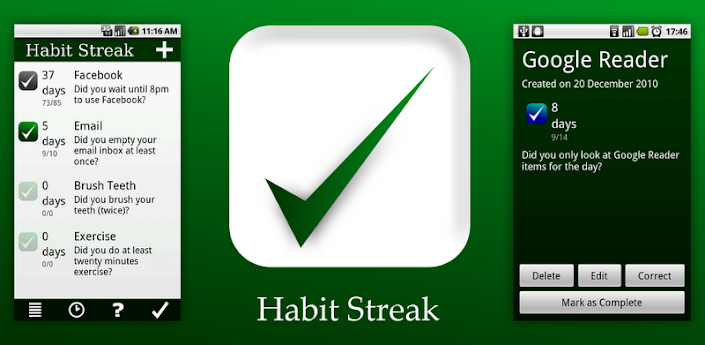
I use HabitStreak (I bought the Pro version) to keep track of my happiness checklist. I like it more than any of the other Android habit tracking apps. Habit Streak works really well for activities that I want to do every day (most of them). I've found it useful to keep up my happiness regime on the weekend as well as during the week. The happiness not-to-dos get converted into positive actions, e.g. "Did you avoid interrupting people today?"

App 2: To Do Log
But then there are some happiness actions that I don't necessarily need to do every day. For example, writing a blog post makes me happy, but it takes a lot of time and I can only really afford to do that on Sundays. So Habit Streak wouldn't work too well for things like that. For that reason, I also use To Do Log.

The cool thing about To Do Log is it gamifies habit tracking. You can assign points to each activity. As an example, to encourage myself to get enough sleep, I've set it up so I get 1 point for every 10 minutes I sleep (a 7 hour sleep is worth 42 points). And to encourage punctuality, I lose 1 point for every 1 minute I am late to a meeting. I really like this combination of positive and negative reinforcement. And I love that I get a score at the end of the day. It means I can try to beat my score from the previous day to reach that impossible asymptote of happiness!

App 3: Moodlytics
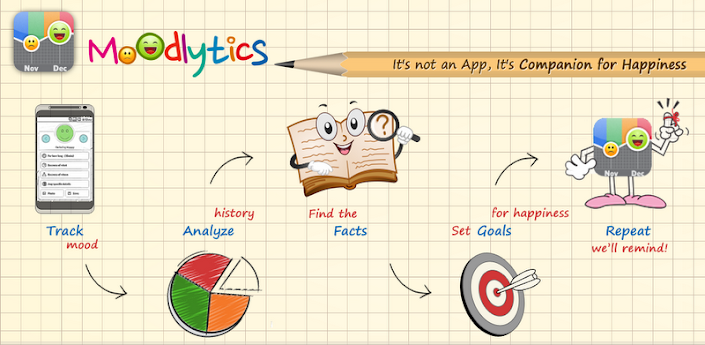
Finally, I've got an app that allows me to measure my actual happiness: Moodlytics. I set it up to quiz me every 30 minutes (my mum thinks this is crazy:P you can set a less frequent interval) about how I'm feeling. The emotions I generally use are: happy, anxious, sleepy or in pain. At the end of the week, I look at the report and add my 'happy' percentage to my spreadsheet, so I can track my happiness over time.

Friday, 2 March 2012

What kind of people are most open to changing their habits?

What was it like the first time you went overseas by yourself?
My first overseas adventure was to Germany in December 2007. I spent 6 weeks in the south of Germany, renting an apartment right next to a corner of the Black Forest. I was there to ski, but as it turned out, there was no snow! So instead I went running. Every morning I'd wake up, put my long johns on and go for a run. During the day, I'd walk around town by myself or just lay back and watch German TV, before going for another run in the evening (yes a lot of running!). Pretty soon I got desperately lonely. One night, I was feeling so upset that I called my parents from my mobile, not caring about the massive bill that I'd get. I was homesick and all I wanted was to hear their voices. I missed my room. I missed the Australian weather. I missed talking to people in English.

Homesickness
After that experience, I had this theory that whenever I went through a big change in my life, I'd soon have a longing for the comforts of home. I started to expect that when hurled into a new situation (either by force or by my own volition), I would retreat from the new experiences on offer and fall back on what I was used to.

As it turns out though, that belief was rubbish when I looked at it objectively. Every time I travelled or went through some major life change (e.g. starting university), even though I often felt like I was falling back on old habits and old comforts and closing myself off to new experiences, my actions painted a very different picture. For example, that same Winter when I was in Germany almost in tears as I called my parents, I had started a new exercise routine, I was sampling a bunch of new foods, I told a girl I loved her, I drank beer for the first time, I learnt how to pick up horse poop, I made a bunch of new friends, I listened to new music and took on many other changes in my life. If I counted up the number of changes I made in my life over those six weeks, it would be immediately clear that I had become more open to change not less open.

The comfort food fallacy
That mistaken belief I had is apparently pretty common. During the height of the GFC, chef and Food Network television host George Duran said, “It’s a natural human habit to turn to comfort foods in times like these” (Parker 2008). However, in a neat series of experiments, Wood (2010) proves that in actual fact, it's a natural human habit to turn to exotic foods in times like these.

Experiment one: do people prefer comfort food in changing times?
In this experiment, Wood first made the 203 American participants do 30-40 minutes of unrelated busy work, so they couldn't figure out the purpose of the study and then gave them a questionnaire that asked them (amongst other things)  whether they were going through significant life changes. Then he asked them to choose a prize: American chips (the comfort food) or British crisps (the exotic, spicy snack). 

The results showed that the people going through major changes in their life were more likely (p = 0.05) to choose the British chips.

Conclusion: people prefer exotic food when their lives are changing rapidly

Experiment two: are people aware of their own preferences for comfort food?
Next Wood asked people to predict what choices two hypothetical people would make: Taylor (who's about to move out of home) and Brook (isn't going anywhere). In all cases, the participants (n = 127) predicted the opposite to how they would have behaved in experiment one. They overwhelmingly believed that Taylor would choose the American chips and Brook would choose the British crisps. When Wood only looked at the participants experiencing a lot of change, he found that they were even more firm in their belief that Taylor would choose the comfort food.

He also did a self-prediction study where he asked 167 students to imagine that they were about to have a really stressful, tumultuous week and then predict whether they would be more or less likely to want to have a comfort food dinner on Friday night. And you guessed it..83% of people reckoned they'd go for the comfort food.

Conclusion: people are really bad at predicting how they would behave.

Experiment three: is it just comfort food or is it comfort anything?
Wood then asked 170 people whether they'd choose the familiar or the unfamiliar option in five different categories (deodorant, music, juice, comedy films, running venues). Yet again, the high change group chose the exotic options (p = 0.03), though this effect evaporated when they were asked  to reflect on why they would choose each option. 

What does it all mean?

The takeaway message is that people are more likely to change their habits when they are in the midst of major changes in their life. (e.g. they move cities or find a new job). I've got a great metaphor here: people are like tents. Their habits are the guide ropes that anchor them to the terrain. Bad habits are anchored at crazy angles that distort the tent and make it very uncomfortable to sleep in and very vulnerable to collapse. 

All of a sudden, a tremendous gust of wind (a significant life change) swoops down and blows the tent. If the tent isn't secured well (maybe because the guide ropes are skewed in strange directions), then the whole tent will collapse and all of the guide ropes will be yanked out of the ground. Then the person inside will rush out to repeg the tent and depending on how they respond to change, they might be methodical and carefully plant the pegs in the most protective manner possible. Or they might peg them higgeldy piggeldy in any which way. Whatever happens, the guide ropes (habits) are probably going to end up stretched in different directions to where they were before.

Implications for marketing
Looking for early adopters? Target people who have recently moved into a new apartment, started a new job or are going through some kind of major life change. This is why men buy Ferraris during their mid life crises:P

For CoCoRide, it would make sense to reach out to new housing developments and offer to set up a ridesharing system for the people who move in.

Implications for individuals
Be aware that if you've put a lot of work into building positive habits (a healthy diet or exercise regime for example), there's a good chance these habits will get broken when your life changes. This was clear for me when I went up to Brisbane recently to visit my PhD supervisor and research group. I picked up some really productive study habits (e.g. using RescueTime.com to block out access to email and facebook in the morning when I wanted to work). However, I lost the habit of regularly journalling and riding my bike to get around. 

Wednesday, 12 January 2011

Set your brain to autopilot: habits for success

I recently read Malcom Gladwell's terrific book, Outliers. He examines the lives of highly successful people like Bill Gates and proposes a reason for their success: the 10,000 hour rule. To be the best, you've got to put in 10,000 hours of practice. And not just any practice - focused practice. It's all about constantly analysing your performance (and better yet, having a coach who can objectively analyse your performance) and adapting how you practise, so that you constantly improve.

I read this and believed it immediately. The best marathon runners take a good ten years of intense training to reach their peak. All up (running, stretching, cross training) they often train three hours per day, which equates to 1000 hours per year. Ten years of that regime is the blueprint for a running machine.

I really liked this concept. A message that I have picked up subconciously over time is that the elite in society are there because they are 'naturally talented'. I used to put these people on a pedestal and would think to myself 'I could never be that person. They were just born that way.' 

Gladwell shows that this is a pretty bogus idea. The top performers in any field: artists, musicians, athletes, speakers, politicians, pilots, comedians, are successful not because they were born that way, but because they've put in thousands of hours of hard effort to improve their craft. 

For me it was very empowering to read this. I now truly believe that I can reach any target I set myself, learn any skill I want to learn and become the person I want to become. All it takes is to have a goal and be willing to put in the work to get there. How much work? 10,000 hours.  

I have to admit though that 10,000 hours is a lot of work. The thought of this much practice felt a bit daunting to me. How could I maintain my motivation to keep putting in the hours of focused practice day after day?  

Recently I worked it out: I just have to stop thinking about it.

Habits for success:
Here's my theory: to rack up 10,000 hours, the practice has to become a habit. Instead of thinking about it, you just do it. And once you do it enough, reinforce those neurological pathways and really drum it into your brain, it becomes a habit. 

An example: running every morning
I used to be really bad at getting going in the morning. I'd lounge around, take a good hour to have breakfast, take another half an hour to shower and get changed and then finally get out the door. Often, I'd take the easy way out. I've set myself a target to run the 6km to uni, so I combine commuting with training. But a lot of days, I'd get up and think "I don't really feel like running. My legs are a bit sore. I'm a bit tired.". Inevitably, I'd cave in and just ride my bike in instead, which isn't much of a workout at all. On top of that, I'd get to uni quite late, because I spent so much time mucking around.

Recently, I've become much better. I run in to uni every morning and I get there early. 

What's changed? I've made it a habit. Now when I wake up, I don't listen to those thoughts. I just grab my bag (which I've packed the night before), put on my shoes and run out the door. What I find is that once I get going, I start feeling good. As I run through the streets, the mental fog of sleepiness gradually wears away and I feel energised. What's more, I'm learning at the same time because I've got podcasts or audio books playing on my MP3 player. 

Running in the morning has become something I just do. It's now a habit. 

Habits for everything
After my success with running in the morning, I'm now looking for habits I can use for all of my goals. Here are some other habits I'm forming:
- Hindi practice: I'm trying to learn Hindi right now, so I've decided to make it a habit to do 10 minutes of Hindi practice during my afternoon tea break.
- Pushups: every time I walk into my room, I drop down and do 20 pushups.  
- MIT planning after dinner: I've found that a guaranteed way to have an effective and productive day is to plan my Most Important Things (MITs) the night before. 
- Yoga before bed: Many nights I find it hard to sleep because I've got so many ideas racing through my head. I've decided to start doing a 20 minute yoga session before bed. This calms me and also improves my flexibility.

What are some habits you could use to start racking up 10,000 hours towards your goals? (And what are the habits that are holding you back?)